

Rummy is more than just a card game in India; it is a tradition, a test of mental agility, and a celebrated game of skill. Whether you are playing for fun at a family gathering or competing in online tournaments, understanding the nuances of the game is the difference between a "Wrong Show" and a triumphant win.
In this guide, we will break down Rummy Terms, Rummy tips and tricks, explore specific 11 card rummy rules, and provide a detailed rummy scoring chart to help you master the table.
Top 10 Rummy Strategies
If you want to compete in high-stakes tournaments or outsmart seasoned players, you must move beyond basic rules. Here are 10 advanced techniques used by Rummy pros in India.
1. The "Fishing" Technique (Baiting)
Fishing is the art of "baiting" your opponent into discarding a card you need.
- How to do it: If you need a $10♠$ to complete a set of 10s and you have an extra $9♠$, discard the $9♠$. Your opponent may assume you aren't building a spade sequence and might safely discard their $10♠$, which you can then pick up to complete your set.
2. Tracking the "Non-Picks"
Most players watch what their opponents pick up. Pros watch what they don't pick up. If an opponent ignores a $7♥$ from the open pile, you can safely assume they aren't building a heart sequence or a set of 7s. This helps you decide which cards are "safe" to discard later.
3. The "Wild Joker" Proximity Rule
Since the Wild Joker can substitute for any card, players tend to hold cards that are numerically close to it (e.g., if $5♣$ is the Joker, players hold $4♣$ or $6♣$).
- The Strategy: Discard cards that are close to the Wild Joker value early on. Opponents are less likely to pick them up because they already have the Joker to fill those gaps.
4. Calculated Dropping: The Art of the "First Drop"
Professional Rummy is as much about minimizing losses as it is about winning.
- The Rule: If you are dealt a hand with no Joker and no potential for a Pure Sequence, take the First Drop (20 points) immediately. It is better to lose 20 points now than to struggle and end up with an 80-point penalty or a 40-point Middle Drop.
5. Holding "Connecting" Middle Cards
Cards like 5, 6, and 7 are the most valuable "natural" cards in the deck.
- Why? A 6 can form a sequence with (4,5), (5,7), or (7,8). High cards (K, Q) and low cards (A, 2) have half as many connecting options. Always prioritize keeping middle cards over extremes.
6. Reverse Psychology Bluffing
If you are one card away from winning, pick a card from the discard pile even if you don’t strictly need it (as long as it doesn't break your hand). This signals to your opponents that you are about to declare, often panicking them into discarding high-value cards they were hoarding, which might be exactly what you need.
7. Discarding High Cards in Pairs
If you have two high cards that don't form a sequence (e.g., $K♥$ and $Q♦$), discard them in back-to-back turns. This confuses opponents regarding which suit you are focusing on and clears your point "dead weight" quickly before they can react.
8. The "Joker as a Bridge" Strategy
Avoid using a Joker to complete a sequence that only needs one more card if that card is a "middle card" (like a 5 or 6). Save the Joker for "dead ends" like Aces or Kings, which are much harder to find in the deck.
9. Color-Alternating Arrangement
This is a simple but vital "pro" habit. Always arrange your cards in Red-Black-Red-Black order. In the heat of a fast-paced 11-card game, this prevents "optical illusions" where you mistake a $7♠$ for a $7♣$, leading to a disastrous Wrong Declaration.
10. The 4-Card Sequence Advantage
Beginners think sequences must be 3 cards. Pros know that a 4-card sequence is often safer. If you have $5-6-7-8$, you can discard either the 5 or the 8 later if you need to "bait" an opponent, without breaking your valid sequence requirement.
Essential Rummy Tips and Tricks to Win
To move beyond being a beginner, you need to apply strategy. Here are the top rummy tips and tricks used by professionals:
- Prioritize the Pure Sequence: This should be your absolute first goal. Without it, your other sets are worth zero in a declaration, and you will be penalized for the full value of your cards.
- Discard High-Value Cards: Keeping Kings, Queens, and Aces is risky. If an opponent declares early, these cards will bloat your score. Unless they fit into a sequence immediately, discard them.
- The "Middle Card" Advantage: Cards like 5, 6, and 7 are more versatile. They can form sequences with a wider range of cards (e.g., a 6 can work with 4-5 or 7-8).
- Watch the Discard Pile: Pay attention to what your opponent picks up from the open deck. If they pick the 7♣, do not discard the 6♣ or 8♣.
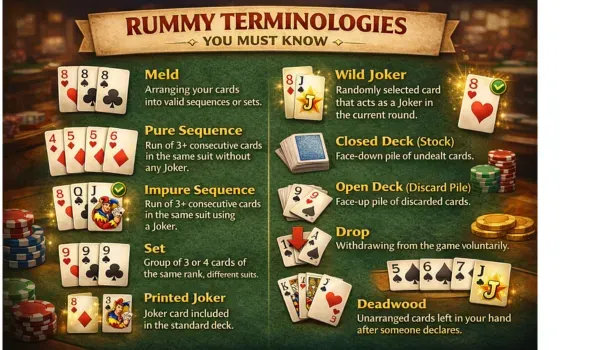
Rummy Terminologies You Must Know
To play like a pro, you need to speak the language. Here are the essential terms used in Indian Rummy:
- Meld: The act of arranging your cards into valid sequences or sets. A winning hand is a fully "melded" hand.
- Pure Sequence: A run of 3+ consecutive cards of the same suit without using any Joker. This is the "soul" of your hand; without it, you cannot win.
- Impure Sequence: A run of 3+ consecutive cards of the same suit that uses a Joker (Printed or Wild) to fill a gap.
- Set: A group of 3 or 4 cards of the same rank but from different suits (e.g., $9♥, 9♠, 9♣$).
- Wild Joker: A card randomly selected at the start of each round to act as a Joker. If the $8♦$ is pulled, all 8s in the deck become Wild Jokers.
- Printed Joker: The card with the Joker image that comes with every standard deck.
- Closed Deck (Stock): The pile of undealt cards kept face-down. Players draw from this to keep their strategy hidden.
- Open Deck (Discard Pile): The pile of cards discarded by players, kept face-up.
- Drop: Withdrawing from the game voluntarily. A First Drop (before your first turn) costs 20 points, while a Middle Drop costs 40 points.
- Declaration (Show): When you have finished melding your cards and place them on the table to end the round.
- Deadwood (Unarranged Cards): Cards in your hand that are not part of any valid sequence or set at the time of someone else's declaration. These determine your penalty points.
How to Play Rummy for Beginners: The Basics
At its core, Rummy is a game of "draw and discard." The objective is simple: arrange the cards dealt to you into valid sequences and sets.
The Deck and Players
- Players: Usually played between 2 to 6 players.
- The Deck: Two standard decks of 52 cards (including one printed Joker per deck) are typically used for 13-card rummy.
- The Deal: In the most popular Indian variant, each player is dealt 13 cards. However, the 11 card rummy variant is also widely popular for faster gameplay.
Objective: What is a Valid Declaration?
To win, you must be the first to "declare" your cards. A valid declaration requires:
- At least two sequences.
- One of these sequences must be a "Pure Sequence."
- The remaining cards must be arranged in sequences or sets.
Understanding Sequences and Sets
The biggest hurdle for beginners is distinguishing between a valid and an invalid hand.
Pure Sequence vs. Impure Sequence
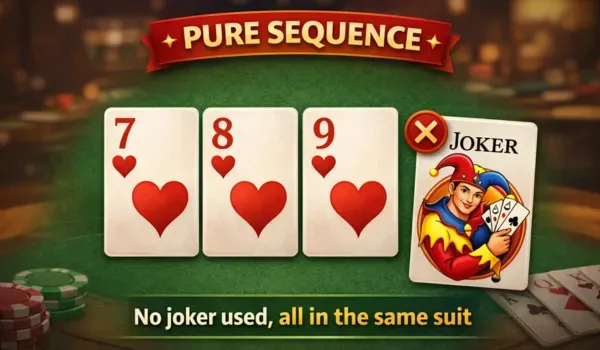
- Pure Sequence: A group of three or more cards of the same suit in consecutive order. Crucially, no Joker can be used here. * Example: 5♥, 6♥, 7♥.
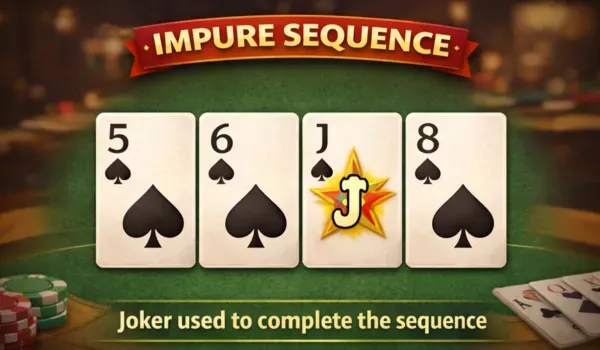
- Impure Sequence: An Impure Sequence is a group of three or more cards of the same suit arranged in consecutive order, where one or more cards are replaced by a Joker (Printed Joker or Wild Joker).
Unlike a pure sequence, the use of a joker makes the sequence impure, but it is still considered valid after forming at least one pure sequence in a hand.
Example:
- 5♠, 6♠, PJ (Printed Joker), 8♠
In this example, the Printed Joker substitutes the 7♠, completing the sequence.
How to Form Sets
A Set consists of three or four cards of the same rank but different suits.
- Valid Set: 7♣, 7♦, 7♠.
- Invalid Set: 7♣, 7♣, 7♦ (You cannot use two cards of the same suit in a single set).
11 Card Rummy Rules vs. 13 Card Rummy
While 13-card rummy is the standard in India, many platforms offer 11 card rummy for those who prefer a quicker pace.
| Feature | 13 Card Rummy | 11 Card Rummy |
| Cards Dealt | 13 Cards | 11 Cards |
| Pure Sequence | Minimum 1 Required | Minimum 1 Required |
| Total Sequences | Minimum 2 Required | Minimum 2 Required |
| Game Pace | Moderate/Strategic | Very Fast |
In 11-card rummy, the pressure to form a pure sequence quickly is even higher, as the game can end in just a few turns.
Rummy Scoring Chart: How Points are Calculated
In Rummy, you want the lowest score possible. The winner of a round always receives 0 points.
Point Values
If you lose, your score is the sum of the points of the cards that are not part of a valid sequence or set.
| Card Type | Points |
| Face Cards (A, K, Q, J) | 10 Points Each |
| Numbered Cards (2-10) | Face Value (e.g., 5 is 5 points) |
| Jokers | 0 Points |
Frequently Asked Questions (FAQs) for Rummy
Is Rummy legal in India?
Yes. The Supreme Court of India has classified Rummy as a "Game of Skill," making it legal to play for free or for cash in most Indian states.
What happens if I make a wrong declaration?
A wrong declaration is the costliest mistake. You will be penalized with the maximum points (usually 80), regardless of the cards in your hand.
Mastering Rummy takes practice and patience. By focusing on your pure sequence first and keeping a close eye on the scoring chart, you can significantly reduce your losses and increase your win rate.
