Callbreak is a popular trick-taking card game played across South Asia, particularly in Nepal, India, and Bangladesh. Combining strategy, prediction, and skillful card play, the game challenges players to accurately bid the number of tricks they can win and then deliver on that promise.
Whether you’re new to Callbreak or looking to improve your game, this guide covers the essential rules, scoring system, gameplay mechanics, and winning strategies you need to know.
What Is Callbreak?
Callbreak is a four-player trick-taking card game played with a standard 52-card deck, where each player competes individually. The goal is to predict how many tricks you can win in a round and then meet or exceed that bid.
The game’s name comes from the strategy of “breaking” an opponent’s call, as players lose points if they fail to reach their declared target. While Callbreak shares similarities with Spades and Bridge, its unique bidding and scoring system create a distinct strategic experience.
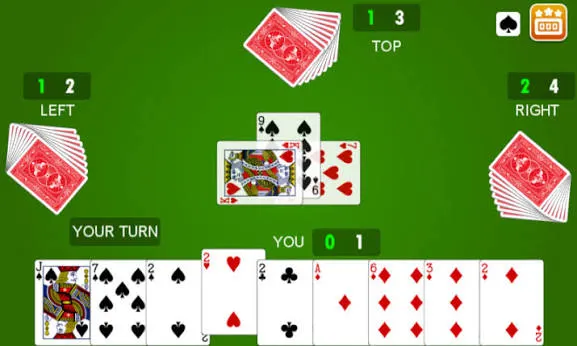
Basic Callbreak Game Setup
Before learning how to play, let’s understand the basic setup.
| Feature | Details |
| Players | 4 |
| Deck | Standard 52-card deck |
| Cards per Player | 13 |
| Game Type | Trick-taking |
| Trump Suit | Spades |
| Typical Game Length | 3–5 rounds (sometimes more) |
Every player receives 13 cards, and all cards are dealt face-down.
Unlike many card games where the trump suit changes, Spades are always the trump suit in Callbreak.
Card Ranking in Callbreak
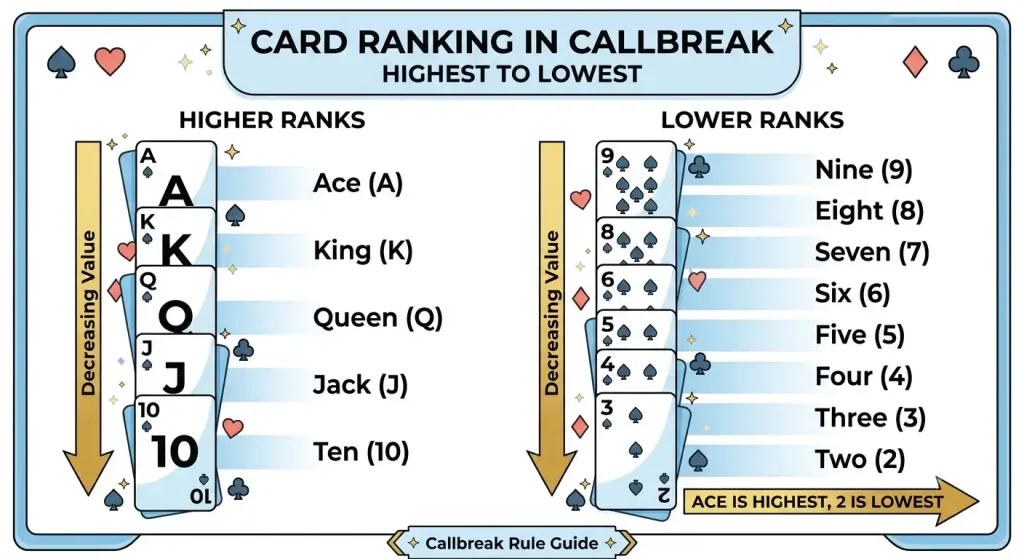
Cards are ranked from highest to lowest as follows:
| Rank |
| Ace (A) |
| King (K) |
| Queen (Q) |
| Jack (J) |
| 10 |
| 9 |
| 8 |
| 7 |
| 6 |
| 5 |
| 4 |
| 3 |
| 2 |
An Ace is the strongest card, while a 2 is the weakest.
However, regardless of rank, any Spade card beats cards from other suits because Spades are the permanent trump suit.
For example:
- 2♠ beats A♥
- 5♠ beats K♦
- Q♠ beats A♣
Understanding the Objective
The primary goal of Callbreak is to finish the game with the highest score.
- Predict how many tricks they can win.
- Successfully achieve or exceed that prediction.
- Prevent opponents from fulfilling their bids whenever possible.
Each round consists of 13 tricks because every player has 13 cards. At the end of the round, points are awarded based on how accurately players fulfilled their bids.
How Bidding Works
After all cards are dealt, players examine their hands and make a bid, known as a call.
A call is simply the number of tricks a player expects to win during that round.
Example
If you believe your hand can win:
- 3 tricks → Call 3
- 5 tricks → Call 5
- 7 tricks → Call 7
The minimum bid is usually 1, while the maximum is 13.
Making accurate bids is one of the most important skills in Callbreak.
Bid too low and you may miss out on potential points. ; Bid too high and you risk receiving a painful negative score.
What to Consider When Bidding
Before making a call, evaluate:
- Number of Spades in your hand
- High cards (Aces, Kings, Queens)
- Strength of individual suits
- Card distribution
- Potential winning combinations
Generally, hands with several high Spades and strong face cards justify higher bids.
Callbreak Step-by-Step Gameplay
Step 1: First Card Is Played
The player next to the dealer starts the first trick by playing any card.
This card establishes the suit for that trick.
Step 2: Following Suit
All remaining players must follow the same suit if they have one.
For example:
If the first player leads with Hearts:
- Other players must play Hearts if possible.
Step 3: Using Trump Cards
If a player doesn’t have a card of the led suit, they may play a Spade.
Because Spades are trump cards, they can beat cards from all other suits.
Step 4: Winning the Trick
The trick is won by:
- The highest Spade played, or
- If no Spade is played, the highest card of the suit led
Example
Cards played:
- A♥
- K♥
- 7♥
- 2♠
Even though the Ace of Hearts is highest in Hearts, the 2 of Spades wins because it is a trump card.
Step 5: Start the Next Trick
The winner of the trick leads the next trick. This continues until all 13 tricks have been completed.
Important Gameplay Rules
Several rules make Callbreak more strategic than many other trick-taking games:
- Play Any Card as a Last Resort – If you have neither the led suit nor a Spade, you may play any card from your hand.
- Follow the Led Suit – If you have a card in the suit that was led, you must play it.
- Try to Win the Trick – In many Callbreak variations, if you can beat the current highest card of the led suit, you should do so.
- Use Trump Cards When Necessary – If you do not have the led suit, you may play a Spade (the trump suit).
Scoring System Explained
When You Meet Your Bid
You earn points equal to your call.
Example:
| Bid | Tricks Won | Score |
| 4 | 4 | 4 points |
| 5 | 5 | 5 points |
When You Exceed Your Bid
You earn your bid plus bonus points. Usually, each extra trick is worth 0.1 points.
Example:
| Bid | Tricks Won | Score |
| 3 | 5 | 3.2 |
| 4 | 6 | 4.2 |
| 5 | 8 | 5.3 |
When You Fail Your Bid
You receive negative points equal to your call.
Example:
| Bid | Tricks Won | Score |
| 4 | 2 | -4 |
| 5 | 4 | -5 |
| 7 | 6 | -7 |
Special Redeal Situations
Many traditional Callbreak games allow cards to be redealt under certain circumstances.
Common redeal conditions include:
No Spades
If a player receives no Spade cards.
No Face Cards
If a player receives no:
- Ace
- King
- Queen
- Jack
Extremely Low Total Bids
Some versions redeal if the combined calls of all players total less than 8.
These rules help ensure fair and competitive rounds.
Beginner Tips for Callbreak
If you’re new to the game, these tips can help you improve quickly:
- Bid Conservatively
Many beginners overestimate their hands. It’s usually safer to bid slightly lower than risk receiving negative points. - Count Your Spades
The number and strength of your Spades should heavily influence your bid. More strong Spades often means more potential tricks. - Save Powerful Cards
Avoid playing your strongest cards too early. They can be far more valuable later in the round. - Watch Every Card
Pay attention to cards that have already been played. This can help you predict what cards your opponents may still hold. - Learn Opponent Tendencies
Some players regularly overbid, while others play too cautiously. Recognizing these patterns can give you a significant strategic advantage.
Advanced Callbreak Strategies
Once you understand the basics, you can start using more advanced tactics:
- Use Low Cards Strategically – Low cards can reveal information, help you control the flow of play, and set up stronger moves later.
- Track Suits Carefully – Keep track of which suits opponents have run out of. This helps you predict when they may use Spades.
- Force Out Opponents’ Trump Cards – Leading certain suits can pressure opponents into spending valuable Spades earlier than they would like.
- Protect Your Bid – If you’re close to fulfilling your call, focus on securing the tricks you still need rather than taking unnecessary risks.
- Break Opponents’ Calls – Winning isn’t only about achieving your own bid. Preventing opponents from reaching theirs can be just as effective.
Common Mistakes to Avoid
Many new players lose points because of avoidable mistakes:
- Playing Too Fast – Take time to think through each move. Small decisions can have a big impact on the final score.
- Overbidding – The most common mistake. Always bid realistically based on the strength of your hand.
- Wasting Spades – Using trump cards too early can leave you vulnerable in later tricks.
- Ignoring Opponent Bids – Knowing what other players need to achieve helps you make smarter decisions.
- Focusing Only on Your Hand – Callbreak is a game of observation. Pay attention to every player’s actions and card choices.
How to Improve Your Callbreak Skills
The best players develop their skills through practice and observation.
To improve:
- Play regularly
- Analyze your mistakes
- Track cards during games
- Experiment with bidding strategies
- Observe experienced players
- Learn from both wins and losses
Over time, you’ll become better at reading situations, estimating tricks, and adapting to changing circumstances.
Try CallBreak Here!
Ready to put your skills to the test? Dubai 7 lets you enjoy Callbreak online against other players anytime, whether you’re practicing your strategy or competing for real.
With a mobile-friendly platform, smooth gameplay, and a wide selection of card games, Dubai 7 makes it easy to play Callbreak wherever you are. New players can also take advantage of regular promotions while enjoying an exciting online gaming experience.
Choose an action below to join the table, secure your welcome bundle, and play with verified players globally.
CallBreak FAQs
Is Callbreak a game of skill or luck?
Callbreak is mostly a game of skill. While the cards you receive involve luck, winning consistently depends on accurate bidding, smart card play, and good strategy.
Can Callbreak be played with fewer than four players?
Traditional Callbreak is designed for four players. While some casual variations exist, the standard game is best played with four participants.
What happens if two players make the same bid?
There is no penalty. Each player’s score is calculated independently based on whether they meet or exceed their own bid.
How many rounds are played in Callbreak?
The number of rounds varies by house rules. Most games are played over 3 to 5 rounds, though longer games are also common.
Can you win more tricks than you bid?
Yes. Extra tricks usually earn small bonus points, though the exact scoring depends on the game variation.
What makes Callbreak different from Spades?
Unlike Spades, Callbreak is played individually instead of in partnerships and uses a different bidding and scoring system.
Are there different versions of Callbreak?
Yes. Some versions have different scoring rules, redeal conditions, or game lengths, but the core gameplay remains the same.
Can Callbreak be played online?
Yes. Many mobile apps and online platforms let you play Callbreak against friends or players from around the world.
What is the best bid for beginners?
There isn’t a fixed best bid. Beginners should make realistic bids based on the strength of their Spades and high cards.
How long does a Callbreak game take?
A typical Callbreak game lasts 20 to 45 minutes, depending on the number of rounds and the pace of play.